
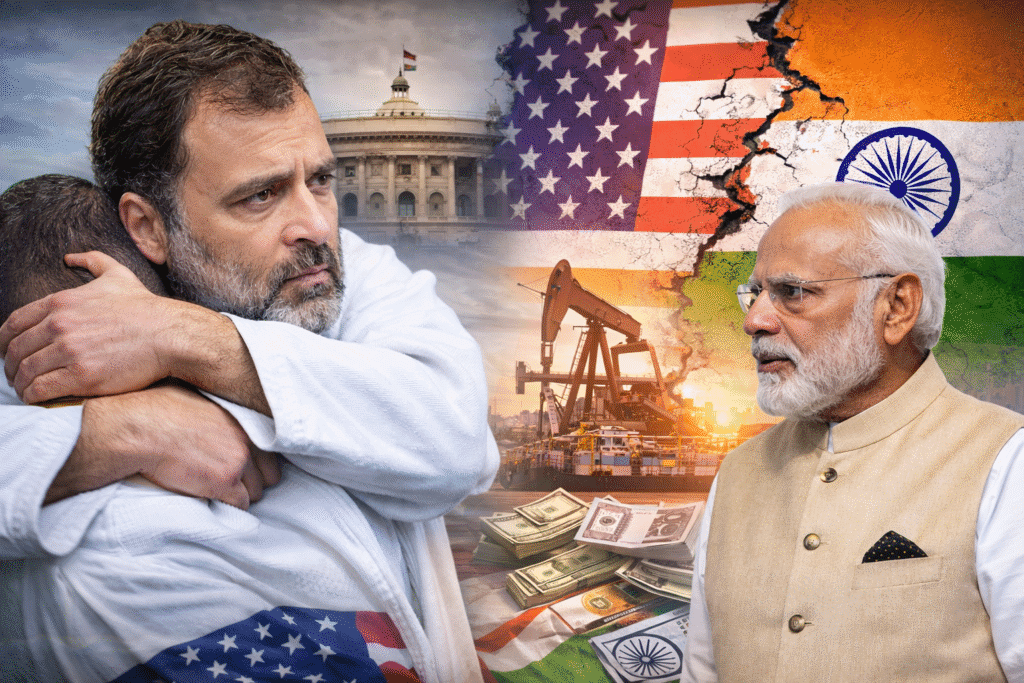
Congress leader Rahul Gandhi has elaborated on his recent use of a Jiu-Jitsu analogy during his speech in Parliament, saying the metaphor was intended to illustrate the subtle but powerful pressures at play in political negotiations.
In a video message shared on social media, Gandhi explained that the concept of “grips” and “chokes” in Jiu-Jitsu refers to techniques used to control an opponent — often without obvious force. He suggested that similar mechanisms operate in politics, where pressure is not always visible but can significantly influence outcomes. According to him, the analogy captured what he believes the Prime Minister was experiencing during negotiations surrounding the trade agreement with the United States.
Gandhi raised a series of pointed questions about the deal. He alleged that Indian farmers might suffer due to expanded market access for American agricultural products. He also questioned provisions related to energy imports, arguing that India’s strategic autonomy in oil sourcing should not be compromised.
Further, Gandhi expressed concern about trade imbalances, claiming the agreement could result in a substantial increase in US exports to India without adequate reciprocal commitments. He also warned about potential risks to India’s digital sovereignty, suggesting that aspects of the deal could weaken the country’s control over its data ecosystem.
The Congress leader concluded by questioning why the government would agree to terms that, in his view, appeared disproportionately beneficial to Washington.
Rahul Gandhi is known to have a background in martial arts. He reportedly holds a blue belt in Jiu-Jitsu and a black belt in Aikido, which he earned in 2013. His February 11 Parliament speech during the Budget session had opened with a mixed martial arts analogy to argue that political power often operates through invisible leverage rather than overt confrontation.
The Bharatiya Janata Party (BJP), however, strongly criticised Gandhi’s remarks. BJP spokesperson Anil Baluni accused him of selectively quoting from an earlier version of a US government fact sheet to build what he described as a misleading argument. Baluni said that misrepresentation weakens democratic debate and called for discussions in Parliament to remain grounded in accurate interpretation of official documents.
The exchange has added to the broader political debate over the contours and implications of the India-US trade arrangement, with both sides presenting sharply contrasting views on its potential economic and strategic impact.
Originally published on 24×7-news.com.