
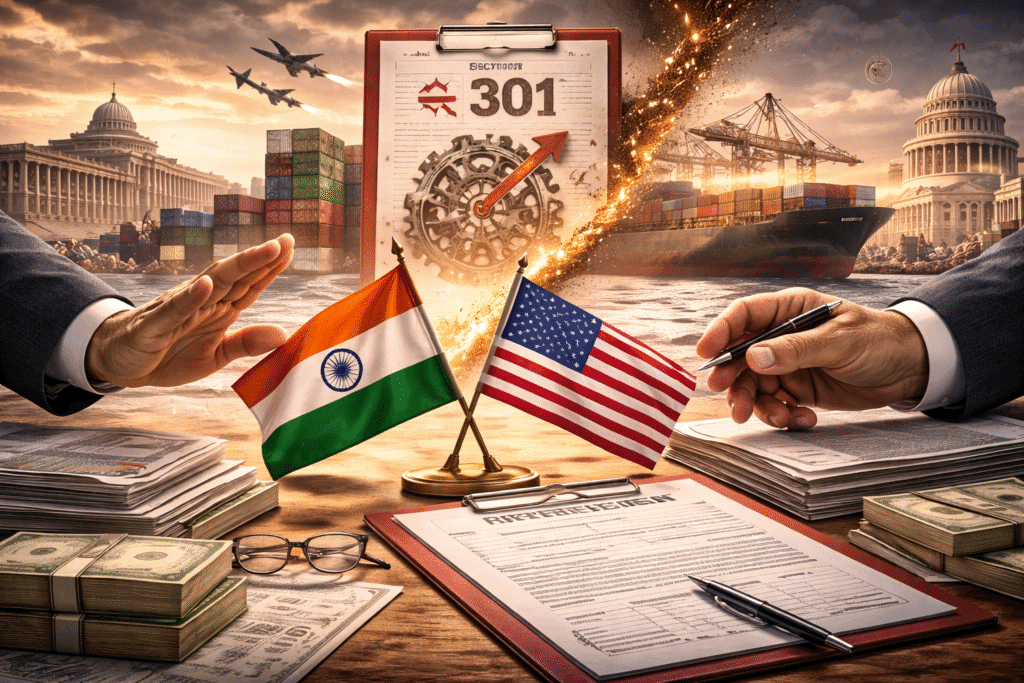
India is expected to move cautiously in its ongoing trade negotiations with the United States as Washington’s decision to initiate an investigation under Section 301 of the US Trade Act could influence the direction of the proposed interim trade agreement between the two countries.
Government sources indicated that New Delhi may wait for greater clarity on the US policy stance before advancing discussions.
According to one official, the decision to invoke Section 301 has already altered the negotiation landscape, potentially affecting the balance of leverage between the two sides.
“It changes the dynamics. Even if progress has been made on a deal, the US may seek to strengthen its negotiating position,” the source said, adding that talks will move forward once the policy outlook becomes clearer.
Interim trade pact under discussion
India and the United States are currently working toward an interim bilateral trade agreement aimed at reducing tariff tensions and expanding market access.
Earlier this year, both countries released a joint statement outlining a framework for the agreement, while reaffirming their long-term goal of achieving a comprehensive Bilateral Trade Agreement (BTA).
Under the proposed interim arrangement, the United States agreed to reduce tariffs on Indian exports to 18 percent, while India would lower or remove duties on certain American industrial goods and a limited range of agricultural products as part of reciprocal market access commitments.
However, India has maintained firm restrictions on US dairy imports, and most of its agricultural sector remains protected from foreign competition.
Officials noted that sectors where imports have been permitted are largely those where trade was already taking place.
India has taken a similar approach in trade negotiations with the United Kingdom and the European Union, where sensitive sectors such as dairy and agriculture have largely remained off-limits.
Talks slowed after US court ruling
Trade discussions had already slowed earlier when a scheduled negotiation round in Washington was postponed following a ruling by the US Supreme Court.
The court struck down the use of the International Emergency Economic Powers Act (IEEPA) as a legal basis for imposing tariffs, forcing the US administration to reassess its tariff policy.
Subsequently, Washington introduced a temporary tariff of 10 percent, with plans to raise it to 15 percent on certain imports.
New Section 301 investigation launched
On March 12, the United States launched a new investigation into global industrial overcapacity across 16 economies, including India.
The probe was initiated by the Office of the US Trade Representative (USTR) under Section 301, a provision that allows the US government to investigate foreign policies that it believes harm American trade and commerce.
The investigation focuses on what the USTR calls “structural excess capacity,” where government policies encourage industries to expand production beyond domestic demand, often resulting in large export surges in global markets.
According to the USTR notice, such policies may involve subsidies, financial incentives, preferential loans, or other forms of state support that allow companies to sustain production levels that would otherwise be economically unviable.
Key sectors under scrutiny
The investigation covers several major industrial sectors, including steel and aluminium, batteries, automobiles, semiconductors, electronics, solar equipment, chemicals, plastics, machinery and shipbuilding.
The USTR will seek public comments and conduct hearings before determining whether these policies place restrictions or create unfair burdens on US commerce.
If the investigation concludes that such practices harm American trade interests, the US administration could impose tariffs or other trade restrictions as corrective measures.
As both countries continue negotiations toward a broader trade framework, India is expected to carefully assess Washington’s next steps before committing to further progress in the interim trade agreement.
Originally published on 24×7-news.com.