
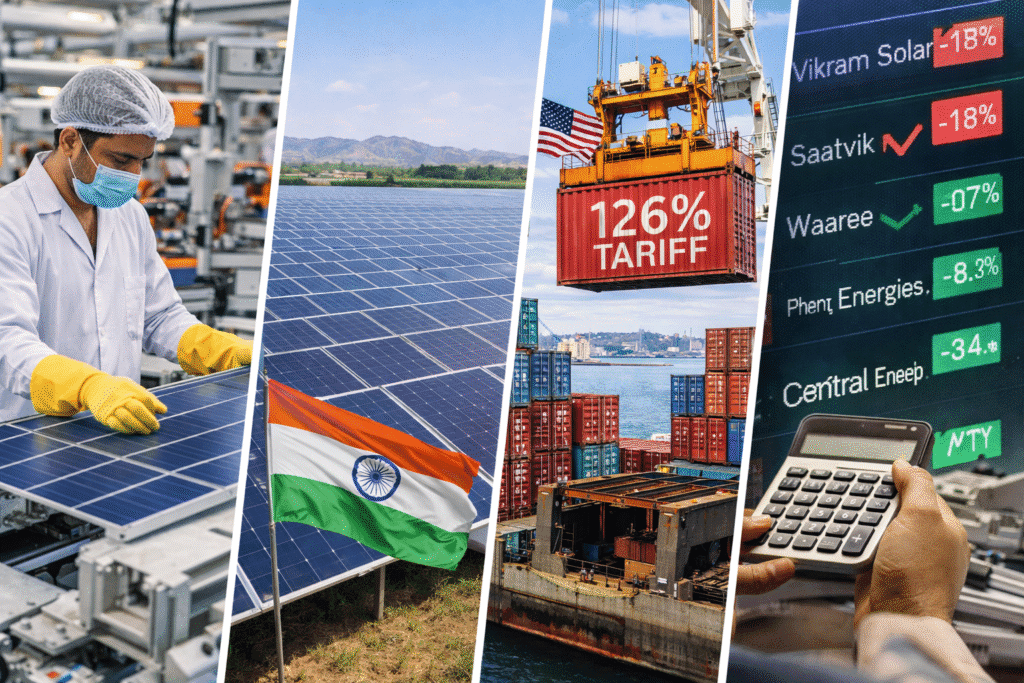
US President Donald Trump has announced a steep 126% tariff on solar imports from India, citing concerns that Indian manufacturers benefit from heavy government subsidies that distort market competition.
The move has sent ripples through India’s solar manufacturing sector, particularly among companies heavily reliant on exports to the United States. Market reactions were swift: while the broader Nifty 50 index posted modest gains over recent trading sessions, several leading solar firms saw sharp declines in share prices.
📦 How Dependent Is India on the US?
India’s solar exports are overwhelmingly tied to the American market.
Out of $2.02 billion worth of solar cell and module exports, approximately 97% — or nearly $1.97 billion — were shipped to the US, according to data from the Ministry of New and Renewable Energy.
This level of concentration has remained consistent since FY2023, making Indian manufacturers highly vulnerable to changes in US trade policy.
📉 Impact on Solar Stocks
Following the tariff announcement:
- Vikram Solar saw a sharp decline
- Saatvik Green Energy dropped significantly
- Waaree Energies and Premier Energies also recorded losses
The development underscores how exposed Indian solar companies are to policy shifts in Washington.
🌞 India’s Solar Expansion
Domestically, India’s solar sector has witnessed rapid growth. According to the Central Electricity Authority:
- Solar power accounted for 10.3% of India’s installed capacity in January 2021
- By January 2026, that share surged to 27%
Solar has been the only major energy segment to increase its proportion in the country’s power mix, while thermal, hydro, and nuclear sources have seen relative declines.
🏭 Subsidies and Manufacturing Growth
A key driver of India’s solar expansion has been the Production-Linked Incentive (PLI) scheme introduced in April 2021. At that time, India’s solar PV module manufacturing capacity stood at around 8.2 GW.
By the end of 2025, capacity expanded dramatically to approximately 144 GW, positioning India as a competitive global supplier capable of meeting domestic demand and supporting exports.
However, it is precisely this rapid scale-up — supported by subsidies — that the US administration argues creates unfair competition for American manufacturers.
🌍 What’s at Stake?
With nearly all solar exports dependent on the US market, the 126% tariff could significantly reshape India’s solar export strategy. Companies may now look toward diversifying export destinations or increasing focus on domestic installations to cushion the blow.
The broader question remains whether trade tensions will escalate further — and how India’s fast-growing renewable sector will adapt to evolving global protectionist policies.
Originally published on 24×7-news.com.