
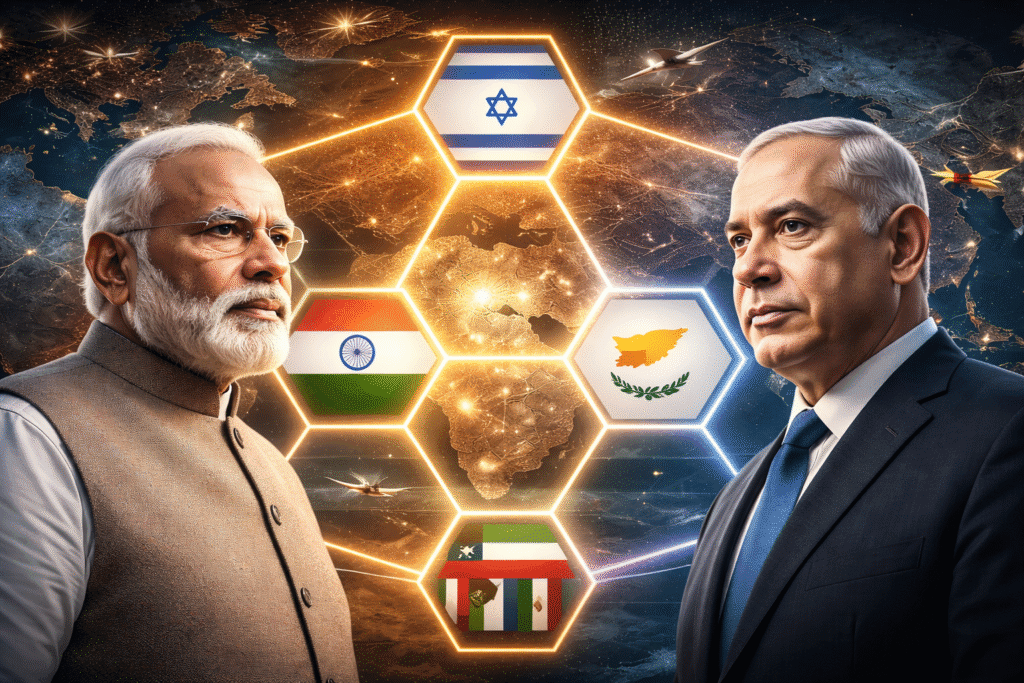
Tel Aviv: Ahead of Prime Minister Narendra Modi’s scheduled visit to Israel on February 25–26, attention has turned to Israeli Prime Minister Benjamin Netanyahu’s proposed “Hexagon Alliance” — a strategic coalition that places India at its core.
Netanyahu has presented the concept as a coordinated network of nations aimed at addressing shared security challenges. While Israel sees India as a crucial pillar in this framework, experts believe New Delhi will approach the idea with caution.
What Is the ‘Hexagon Alliance’?
Netanyahu described the proposed alliance as a six-sided strategic grouping involving Israel, India, Greece, Cyprus, and a mix of select Arab, African, and Asian countries. The goal is to build a broader diplomatic, economic, and security coalition to counter what he calls the “radical Shia axis” and the “emerging radical Sunni axis.”
Iran is widely viewed as the central focus of Israel’s concerns within this framework. By positioning India as a central partner, Israel aims to expand its diplomatic outreach and reduce its geopolitical isolation.
How the Alliance Is Intended to Function
The proposed bloc would extend beyond military coordination. According to Israeli officials, the alliance would promote cooperation across security, trade, energy, intelligence-sharing, and diplomatic engagement.
Mediterranean nations such as Greece and Cyprus are envisioned as strategic connectors between Europe and Asia, while India’s economic and geopolitical influence in South Asia makes it a key strategic partner in Netanyahu’s vision.
India-Israel Relations: A Growing Partnership
Over the past decade, ties between India and Israel have strengthened significantly. Prime Minister Modi became the first Indian Prime Minister to visit Israel in 2017, marking a new chapter in bilateral relations.
Defense cooperation remains a cornerstone of the relationship. India is one of the largest buyers of Israeli defense equipment, and both countries collaborate closely on intelligence and advanced military technologies.
However, deeper strategic cooperation does not necessarily translate into participation in a formal geopolitical bloc.
India’s Strategic Dilemma
Analysts argue that joining such an alliance would pose significant diplomatic challenges for India.
New Delhi has traditionally maintained a balanced foreign policy approach in West Asia, nurturing strong ties with Israel while simultaneously supporting Palestine and maintaining close relationships with Arab nations and Iran.
Any move perceived as aligning India against Iran or sidelining Palestine could complicate its longstanding diplomatic positioning.
Moreover, millions of Indian nationals work across Gulf and Arab countries. A visible military alignment in a Middle East security bloc could carry economic and political risks.
Strategic Autonomy at Stake
India’s foreign policy has long been guided by the principle of strategic autonomy. Joining a bloc explicitly framed around countering specific regional powers could be interpreted as a departure from this approach.
Experts suggest that while India will continue strengthening bilateral ties with Israel — particularly in defense, technology, and innovation — it is unlikely to formally join a military or security alliance that alters its broader West Asia policy balance.
What to Expect During Modi’s Visit
Prime Minister Modi’s visit is expected to focus on bilateral cooperation in defense, trade, agriculture, water management, and technology.
While discussions around the “Hexagon Alliance” may occur, analysts believe India will proceed cautiously, carefully weighing geopolitical implications, regional sensitivities, and long-term economic interests.
In diplomatic terms, announcements may be bold — but decisions will likely be measured.
Originally published on 24×7-news.com.