
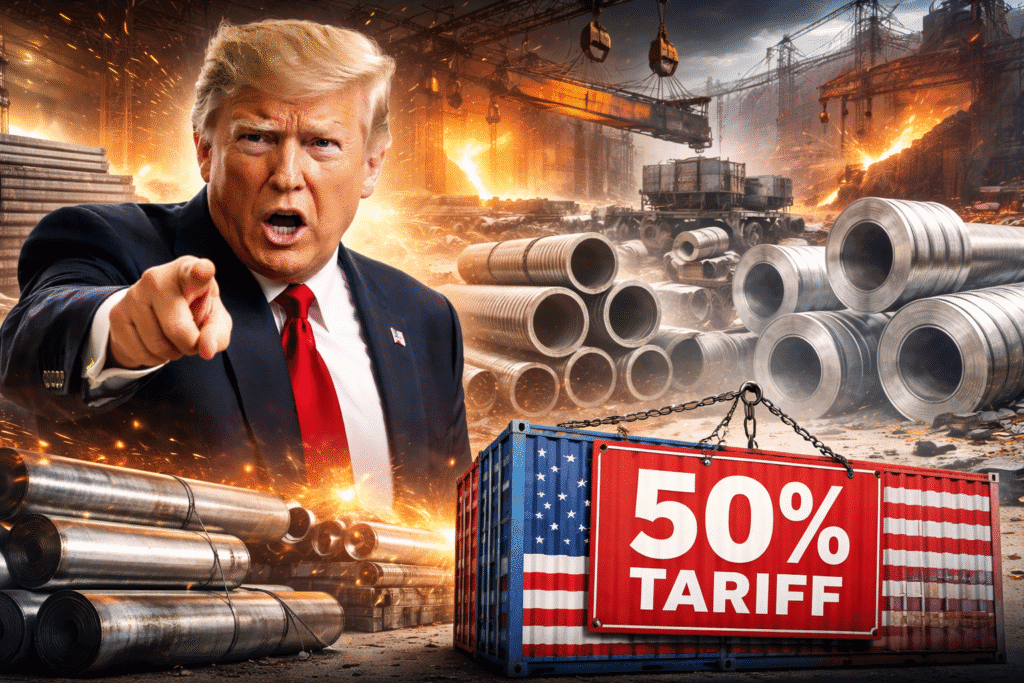
The US administration under President Donald Trump is reportedly reassessing its aggressive tariff regime on steel and aluminium, signaling a possible shift in trade policy after months of criticism from businesses and lawmakers.
According to reports by the Financial Times and Bloomberg, officials at the Office of the US Trade Representative (USTR) are exploring options to narrow the scope of the 50% tariffs imposed last year on foreign steel and aluminium imports.
The duties, introduced as part of a broader strategy targeting global overcapacity — particularly from China — were also applied to major US trading partners including Canada, the European Union, Mexico and South Korea.
What Could Change?
Sources familiar with the matter suggest that the administration is reviewing the list of products currently covered by the tariffs. The move could result in:
- Scrapping tariffs on select steel and aluminium products
- Halting further expansion of the tariff list
- Launching more targeted national security investigations into specific goods instead of broad-based levies
While no official announcement has been made, companies have reportedly been informed that adjustments are under consideration. However, details regarding timing and scope remain unclear.
Why the Rethink?
The tariffs, originally intended to protect domestic industries, have come under scrutiny for contributing to rising prices of consumer goods made with steel and aluminium — including washing machines, microwave ovens, food containers and beverage cans.
Critics argue that American consumers and businesses are absorbing much of the cost burden. Recent analyses from the Congressional Budget Office and the Federal Reserve Bank of New York reportedly indicate that US importers — rather than foreign exporters — are paying the tariffs, contradicting earlier claims that the financial impact would fall primarily on overseas producers.
Officials are also said to be concerned that the current tariff framework is “too complicated to enforce,” prompting discussions about simplifying or overhauling the system.
Political and Economic Implications
Trump’s tariff policies have pushed US import duties to levels not seen since before World War II, marking one of the most aggressive protectionist trade stances in decades. However, the policy has sparked debate in Congress, including bipartisan criticism over executive use of trade powers.
A rollback or recalibration of the steel and aluminium tariffs could signal a more targeted approach — balancing domestic industry protection with consumer cost concerns and global trade relations.
For global markets, any shift in US tariff policy could have ripple effects, particularly for key exporters and industries dependent on metal supply chains.
As trade negotiations and economic pressures intensify, the coming weeks may reveal whether the administration opts for a significant policy reset or a limited adjustment to its current tariff strategy.
Originally published on 24×7-news.com.