Congress Flags Concerns Over Proposed Lok Sabha Expansion
The Indian National Congress has raised strong objections to a reported proposal by the Centre to increase the strength of the Lok Sabha by nearly 50%, warning that the move could create regional imbalances in political representation.
According to party leaders, the proposal is being pushed forward rapidly and could significantly alter the current distribution of parliamentary seats across states.
What the Proposal Suggests
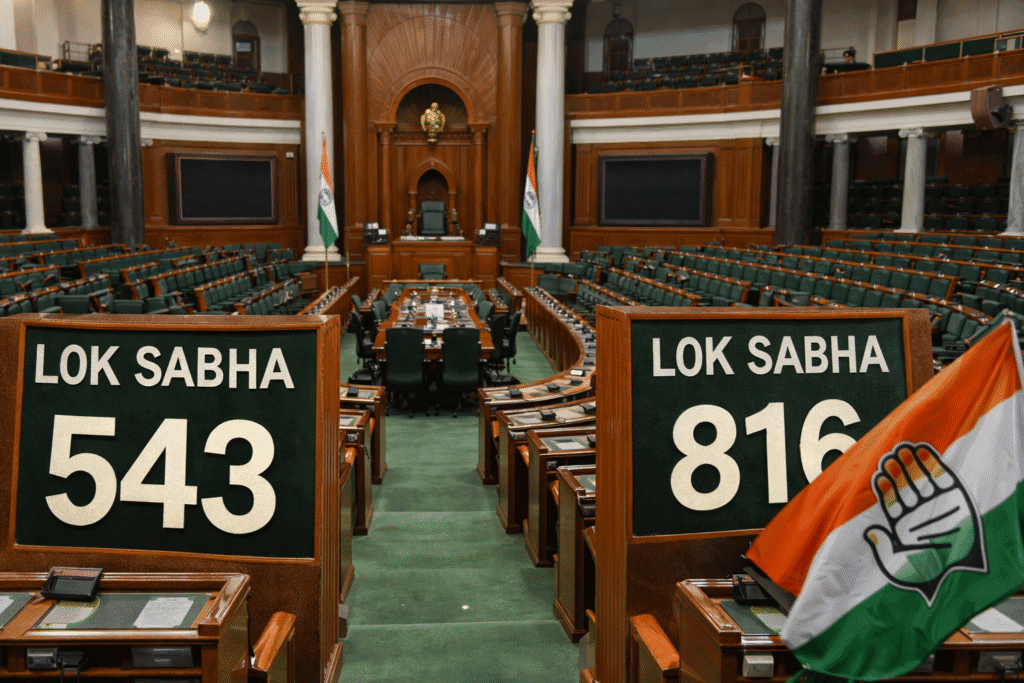
The plan under discussion involves expanding the Lok Sabha from 543 seats to 816 seats—an addition of 273 members. These additional seats are expected to be reserved for women as part of the implementation of 33% reservation in Parliament and state assemblies.
If implemented, the majority mark in the Lok Sabha would rise to 409 seats.
Concerns Raised by Congress
Senior Congress leader Jairam Ramesh argued that while a uniform increase in seats may appear fair on the surface, it could lead to deeper structural imbalances.
He highlighted that larger northern states could gain disproportionately compared to southern and smaller states, potentially shifting the balance of political power.
State-Wise Impact: A Growing Divide?
The proposed expansion could significantly increase seat counts across states:
- Uttar Pradesh: 80 → ~120 seats
- Bihar: 40 → ~60 seats
- Maharashtra: 48 → ~72 seats
- West Bengal: 42 → ~63 seats
- Tamil Nadu: 39 → ~59 seats
- Kerala: 20 → ~30 seats
While all states would see an increase, the overall gains are expected to be much higher for northern states compared to southern regions.
According to estimates cited by Congress leaders, southern states may gain around 66 additional seats collectively, while northern states could gain close to 200—raising concerns about long-term political imbalance.
Impact on Smaller States and Union Territories
Smaller states and union territories would also see modest increases:
- States like Arunachal Pradesh, Goa, Manipur, Meghalaya, and Tripura may rise from 2 to 3 seats
- Mizoram, Nagaland, and Sikkim could double from 1 to 2 seats
Among union territories:
- Delhi: 7 → 11 seats
- Jammu & Kashmir: 5 → 8 seats
Political Reactions and Growing Debate
The proposal has triggered concerns beyond the Congress party. Leaders from southern states, including Telangana, have already voiced apprehensions over the potential loss of proportional representation.
Critics argue that the move could disadvantage regions that have successfully controlled population growth, as seat allocation is closely linked to population size.
What Happens Next?
The Centre is expected to introduce legislation, including a constitutional amendment, to implement the expansion along with women’s reservation. If passed, the changes could come into effect from the next general elections.
The proposal is likely to spark intense debate in the coming months, as political parties weigh its long-term impact on India’s federal structure and electoral balance.
Originally published on 24×7-news.com.