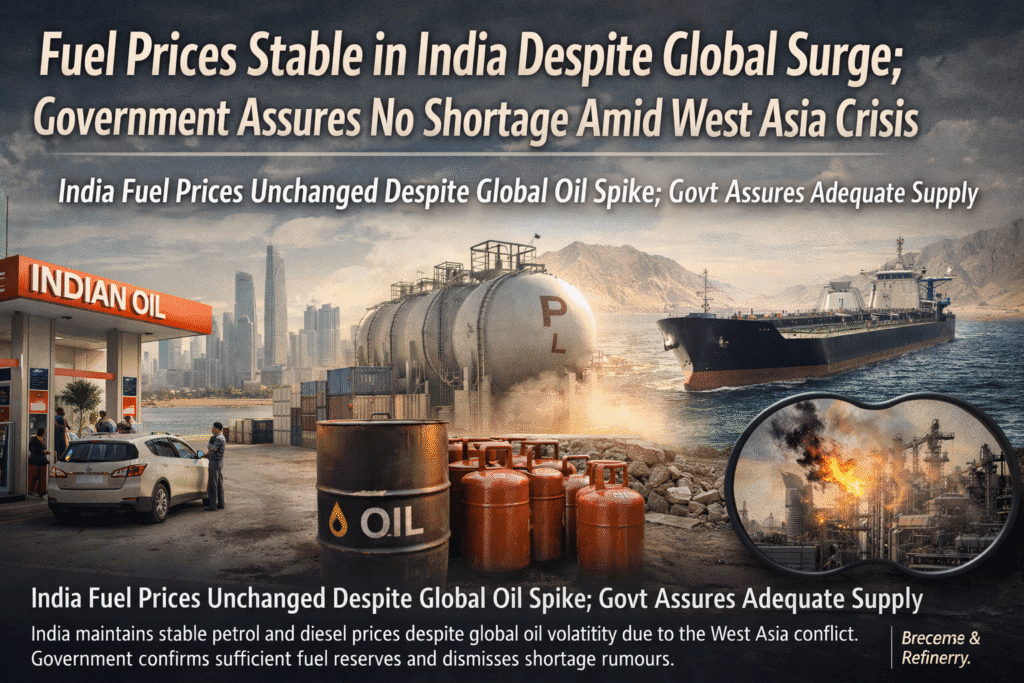
India has maintained stable retail prices of petrol and diesel despite a sharp rise in global crude oil prices triggered by the ongoing West Asia conflict, as state-run oil marketing companies continue to absorb cost pressures.
Public sector firms — Indian Oil Corporation (IOC), Bharat Petroleum Corporation Ltd (BPCL), and Hindustan Petroleum Corporation Ltd (HPCL) — which control nearly 90% of the fuel retail market, have kept regular fuel prices unchanged since April 2022. In Delhi, petrol remains at ₹94.77 per litre and diesel at ₹87.67 per litre.
However, these companies recently increased prices of premium petrol by ₹2 per litre and raised bulk diesel rates for industrial consumers by around ₹22 per litre. Industry reports indicate that refiners are currently incurring losses of over ₹50 per litre on diesel and around ₹20 per litre on petrol due to suppressed retail pricing.
The price pressures stem from geopolitical tensions in West Asia, which pushed crude oil prices to nearly $119 per barrel earlier this month before easing to around $100. As India imports close to 90% of its crude oil, disruptions—especially around the Strait of Hormuz—pose a significant risk.
Private fuel retailers such as Nayara Energy have begun passing on the increased costs to consumers, raising petrol prices by up to ₹5 per litre and diesel by around ₹3 per litre, depending on state taxes. Unlike public sector firms, private retailers do not receive government support to offset losses.
Despite concerns, the government has strongly reassured citizens that there is no shortage of petrol, diesel, or LPG in the country. The petroleum ministry stated that India currently holds around 60 days of fuel stock, with a total reserve capacity of approximately 74 days.
To strengthen supply, domestic LPG production has been increased by 40%, reaching about 50,000 tonnes per day. Additionally, around 800,000 tonnes of LPG imports have been secured from multiple countries including the United States, Russia, and Australia.
Recent shipments, including LPG carriers passing through the Strait of Hormuz and arrivals at ports such as New Mangalore, have further eased supply concerns. Authorities emphasised that all fuel outlets across the country are operating normally, with no rationing in place.
The government also dismissed reports of shortages and panic buying as misinformation, urging citizens to rely only on verified updates. It noted that India has diversified its crude oil sourcing to over 40 countries, reducing dependence on any single region.
Meanwhile, political reactions have surfaced, with opposition leaders criticising the government over inflation and LPG-related concerns. However, officials reiterated that India’s energy supply remains secure and stable even as global markets face volatility.
Prime Minister Narendra Modi is scheduled to hold a virtual meeting with Chief Ministers to review preparedness and ensure coordinated response measures amid the ongoing geopolitical situation.
Originally published on 24×7-news.com.