
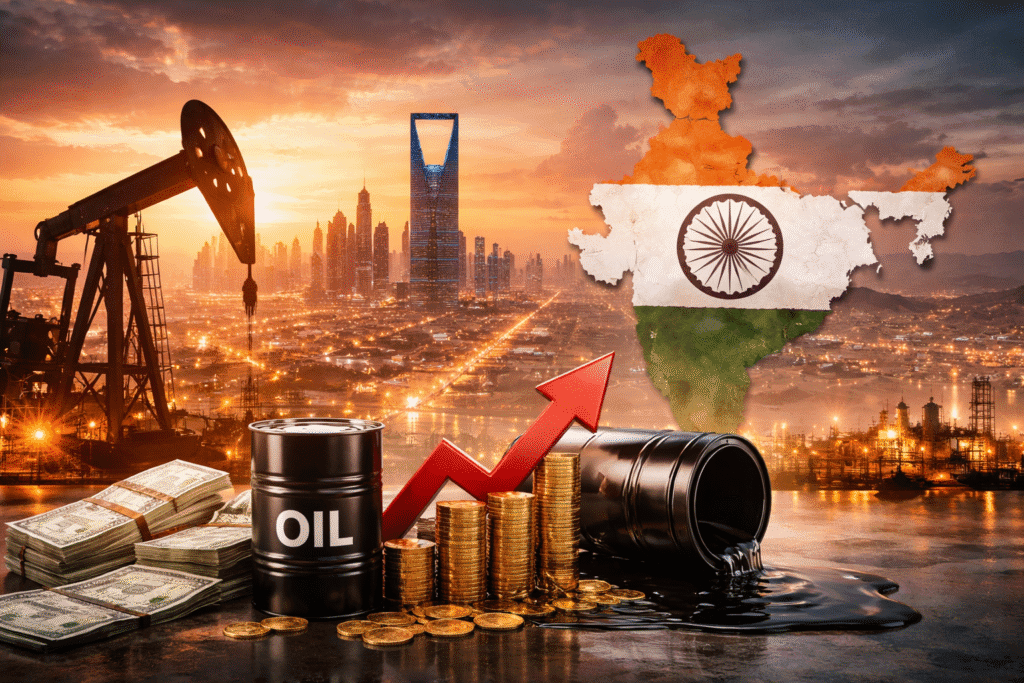
The ongoing Iran conflict has pushed global oil markets into turmoil, placing Saudi Arabia in an unexpected position. While rising crude prices typically boost revenues for oil-exporting nations, Saudi policymakers are increasingly concerned about the long-term consequences of extreme price spikes.
According to a Wall Street Journal report, Saudi officials are evaluating worst-case scenarios in which Brent crude could exceed $180 per barrel if disruptions persist. Rather than celebrating higher prices, Riyadh fears that such a surge could destabilize global markets, weaken demand, and trigger a broader economic slowdown.
Energy analysts note that Saudi Arabia generally prefers stable and moderate price increases, as sudden spikes can damage long-term consumption patterns and harm global economic growth.
Oil Markets Tighten as Conflict Escalates
Since late February, tensions in the Middle East have significantly disrupted energy flows. Attacks on key infrastructure and continued threats around the Strait of Hormuz—a route responsible for nearly 20% of global oil supply—have tightened global markets.
Brent crude prices have already climbed to around $119 per barrel, while regional benchmarks linked to Oman crude have surged even higher. Saudi crude shipments to Asian markets are currently priced above $125 per barrel, reflecting tightening supply conditions.
Market projections suggest oil prices could continue rising, potentially reaching $140 in the near term and climbing toward $150 or beyond by mid-April. In extreme scenarios, analysts believe prices could touch $165–$180 per barrel if the conflict intensifies further.
Global Economic Pressure Mounts
The surge in oil prices is already impacting economies worldwide. In the United States, fuel prices have risen sharply, increasing costs for both households and businesses. Experts describe higher fuel costs as an indirect tax that reduces consumer spending and slows economic activity.
Central banks are also facing challenges, as rising energy costs contribute to inflation while simultaneously putting pressure on economic growth and employment.
India Faces Significant Risks
India is particularly vulnerable to the ongoing oil shock due to its heavy reliance on imports, which account for nearly 90% of its crude requirements. Rising oil prices could have wide-ranging consequences for the country’s economy.
If crude prices climb to the $150–$180 range and remain elevated:
- The current account deficit could exceed 3% of GDP
- The Indian rupee may weaken under external pressure
- Inflation could increase by more than 1 percentage point
- Economic growth could slow significantly
Such conditions would present a difficult challenge for policymakers, especially the Reserve Bank of India, which may need to balance inflation control with growth concerns.
Limited Buffers but Growing Challenges
India has previously taken steps to cushion the impact of rising fuel prices, including cutting excise duties and increasing imports of discounted crude from alternative suppliers like Russia. However, sustained high oil prices could strain these measures and limit their effectiveness.
As the conflict continues to disrupt global energy markets, both oil-producing and oil-importing nations face growing uncertainty, with the risk of prolonged economic pressure looming large.
Originally published on 24×7-news.com.