Israel is believed to have used an advanced ballistic missile capable of briefly travelling into space before descending at high speed during the strike that reportedly killed Iran’s Supreme Leader Ali Khamenei in Tehran.
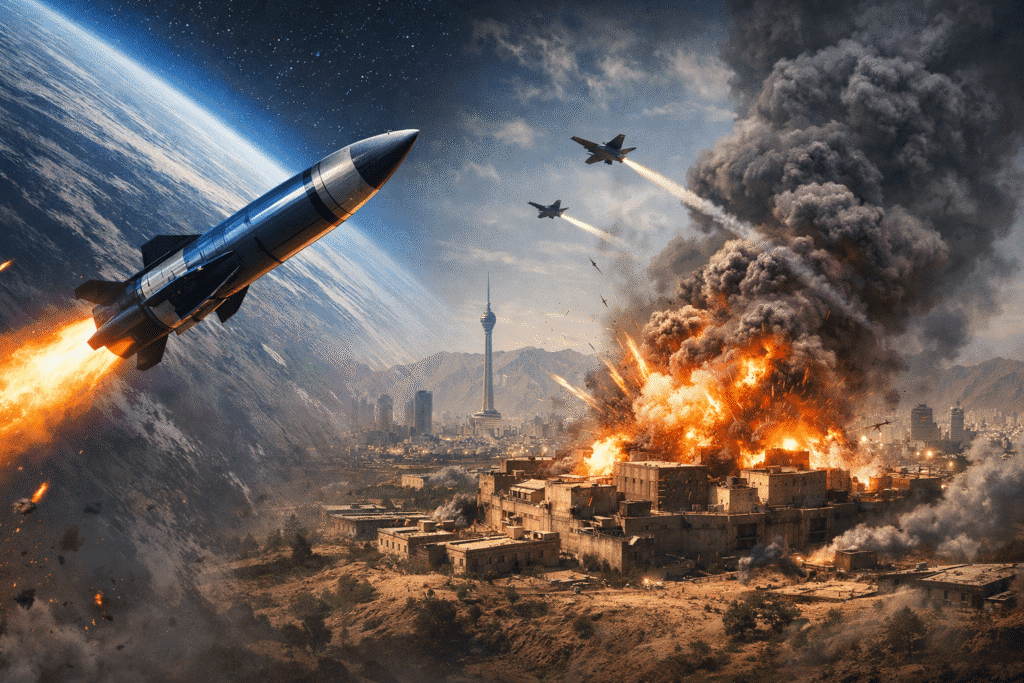
According to reports, the weapon used in the operation was the Blue Sparrow missile, a system developed by Israel that follows a quasi-ballistic path. The missile briefly exits the Earth’s atmosphere and then re-enters at extremely high speed, making it difficult for traditional air-defence systems to detect or intercept.
Fragments believed to belong to the missile were reportedly discovered in western Iraq, along what analysts suspect was the weapon’s flight path toward Tehran.
What Is the Blue Sparrow Missile?
The Blue Sparrow is part of a family of missile systems developed by Israel primarily for testing air-defence systems. The missile has an estimated operational range of around 2,000 kilometres (1,240 miles).
Measuring roughly 6.5 metres in length and weighing about 1.9 tonnes, the system was originally designed to simulate enemy ballistic missiles during defence exercises. Over time, however, the technology is believed to have evolved into an offensive strike capability capable of hitting strategic targets with high precision.
The Blue Sparrow belongs to a broader missile series that includes the Black Sparrow and Silver Sparrow variants. These missiles were initially developed to replicate Scud-type ballistic threats similar to those launched against Israel during the Gulf War.
Why It Is Difficult to Intercept
The missile’s unique trajectory is what makes it particularly challenging to stop. By briefly leaving the atmosphere before descending rapidly toward its target, the weapon shortens the warning time available to defensive systems.
Defence analysts say such a flight path complicates radar tracking and interception, making it suitable for precision strikes against heavily fortified or high-value targets.
There have been earlier reports suggesting that similar missile systems may have been used during Israeli strikes on Iranian positions in April 2024, when comparable debris was reportedly found.
Years of Intelligence Preparation
Reports suggest the operation was the result of years of intelligence gathering by Israel’s elite cyber and signals intelligence unit, Unit 8200.
For more than two decades, the intelligence unit is believed to have monitored the movements of Khamenei’s security personnel and gathered surveillance data around his compound in Tehran. This reportedly included infiltrating traffic camera networks and monitoring movement patterns in the area.
Sources claim the attack had been prepared months in advance but was launched when intelligence indicated that the Iranian leader would attend a meeting at his compound.
A Carefully Planned Operation
Iranian officials had reportedly anticipated that any Israeli strike would take place at night. Khamenei was known to spend many nights inside a heavily fortified underground bunker located deep beneath his residence — a descent reportedly taking nearly five minutes.
According to reports, Israeli military leadership used deception tactics before the operation. Images were released suggesting that top Israeli commanders were heading home for the weekend and preparing for Shabbat.
However, this was reportedly a strategic move. Senior commanders later returned to military command centres, some reportedly in disguise, before the operation began.
The Attack on Tehran
The assault reportedly began early in the morning. Israeli F-15 fighter jets took off around 7:30 AM Iran time and reached their launch positions roughly two hours later.
At approximately 9:40 AM, coordinated strikes were launched against multiple locations within the compound.
Around 30 precision strikes were reportedly carried out during the operation. At the same time, communications in the surrounding area were disrupted, preventing immediate response or calls for assistance.
Videos circulating online later showed smoke rising from several locations in Tehran, including the targeted complex. Reports indicate that at least six buildings inside the compound were destroyed or heavily damaged.
Iranian state media confirmed Khamenei’s death the following morning.
US Weapons Also Used in Wider Assault
The broader military campaign reportedly involved support from the United States, which deployed several advanced weapons systems.
The Pentagon released images showing the first combat use of the Precision Strike Missile (PrSM) — a long-range surface-to-surface missile with an estimated range of around 310 miles.
In addition, US forces reportedly launched Tomahawk cruise missiles and HIMARS rockets during strikes targeting Iranian military assets.
According to US Central Command chief Brad Cooper, American forces struck more than 2,000 targets across Iran and destroyed 17 Iranian vessels during the initial phase of the conflict.
Israel also stated that it dropped approximately 2,000 bombs within the first 30 hours of the war as part of its military campaign.
Originally published on 24×7-news.com.